Drug Monitoring
Explain clinical drug monitoring with regard to peak and trough concentrations, minimum therapeutic concentration and toxicity
Drug monitoring describes the individualisation of dosing by maintaining plasma drug levels within a target range. Drug monitoring is indicated to:
- Avoid toxicity
- Adjust dosing for efficacy
- Monitor compliance
- Account for high inter-patient variability in response
Variability can be:- Pharmacokinetic
Adjusting drug dose by monitoring plasma levels reduces pharmacokinetic variability. - Pharmacodynamic
Drug dose is adjusted by evaluating the clinical effect.
- Pharmacokinetic
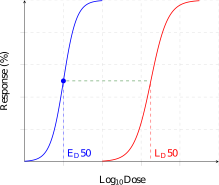
Therapeutic Index
The therapeutic index is:
- \(Therapeutic \ Index = {LD_{50} \over ED_{50}}\), where:
- ED50
The dose required to produce the minimum clinical effect in 50% of the population. - LD50
The dose which is lethal in 50% of the population.
- ED50
- An indication of how safe a medication is at the prescribed dose
- A higher TI indicates a greater margin for safety
A drug generally has a good safety profile if it has a TI >10. - Drugs with a narrow TI have a small range between dose for efficacy and dose for harm
- A higher TI indicates a greater margin for safety
Narrow therapeutic index drugs are also known as “critical dose drugs” or drugs with a “narrow therapeutic range”. They are defined as drugs where the TI:
- TI is <2
- Ratio of the minimum toxic concentration and minimum therapeutic concentration is <2
- Safe use requires titration and monitoring
A related term is the therapeutic range, or therapeutic window, which is the difference between the minimum therapeutic concentration and the minimum toxic concentration.
Indications
Drugs are monitored in order to:
- Avoid toxicity
- Adjust dosing for efficacy
- Monitor compliance or determine failure of therapy
Drugs that typically require monitoring have a:
- Narrow target range
- Significant pharmacokinetic variability
- Relationship between the concentration in plasma and clinical effects
- Determined concentration range
- Validated monitoring assay
Drugs where the effect can be measured clinically (e.g. antihypertensives) tend to be adjusted based on observed effects. This is not possible when:
- The clinical response is the absence of a condition, e.g. antiepileptics
- The drug has a narrow therapeutic range
Drugs commonly monitored in the ICU setting include:
| Drug | Therapeutic Range |
|---|---|
| Digoxin | 0.8-2 microgram/L |
| Vancomycin | 10-20 mg/L* |
| Tacrolimus | 5-20 microgram/L |
| Serolimus | 5-15 microgram/L |
| Phenytoin | 10-20 mg/L |
| *Trough |
Timing of samples
- Sampling for toxicity should occur at times of peak concentration
- This requires accounting for absorption and distribution
- e.g. Digoxin levels should be performed >6 hours following a dose to allow time for distribution to occur
- If symptomatic, samples taken at this time may demonstrate toxic concentrations
- This requires accounting for absorption and distribution
- Sampling for monitoring should ideally occur at steady state
- i.e. after 4-5 elimination half-lives
- For drugs with very long half-lives (such as amiodarone), sampling tends to occur earlier to ensure toxic levels have not been reached, as steady state may take months to achieve
- For drugs with short half-lives, trough levels (i.e. pre-dose levels) should be taken
This is the least variable point in the dosing interval. - For drugs with long half lives, timing of sampling is less important
Interpretation
Interpretation of drug levels is dependent on:
- Timing of sample
- Duration of treatment at the current dose and dosing schedule
- Individual characteristics that may affect the pharmacokinetics
- Age
- Physiology
- Comorbidities (hepatic, renal, cardiac)
- Drug interactions
- Genetics
- Environmental
- Protein binding
- Assays measure bound and unbound drug
Only unbound drug is pharmacologically active. - If binding is changed by disease or displacement by other drug, the proportion of unbound drug may change and targeted levels may need to be adjusted accordingly
- Assays measure bound and unbound drug
- Active metabolites
Active metabolites are not measured but will contribute to the response.
References
- Birkett DJ. Therapeutic drug monitoring. Aust Prescr 1997;20:9-11.
- Ghiculescu RA. Therapeutic drug monitoring, which drugs, why, when, and how to do it. Aust Prescr 2008;31:42-4.
- Tamargo J, Le Heuzey JY, Mabo P. Narrow therapeutic index drugs: a clinical pharmacological consideration to flecainide. Eur J Clin Pharmacol. 2015;71(5):549–67.
- Gerlach, A.T., Saliba, L. (2016). Practical Pharmacokinetics and Pharmacodynamics. In: Martin, N.D., Kaplan, L.J. (eds) Principles of Adult Surgical Critical Care. Springer, Cham.